Free Guides And Articles To Help You Build The Modern Fit Physique
Learn the important training, nutrition, and lifestyle principles and strategies that are crucial for building the Modern Fit Physique.
Reps In Reserve And Intensity For Building Muscle
Intensity
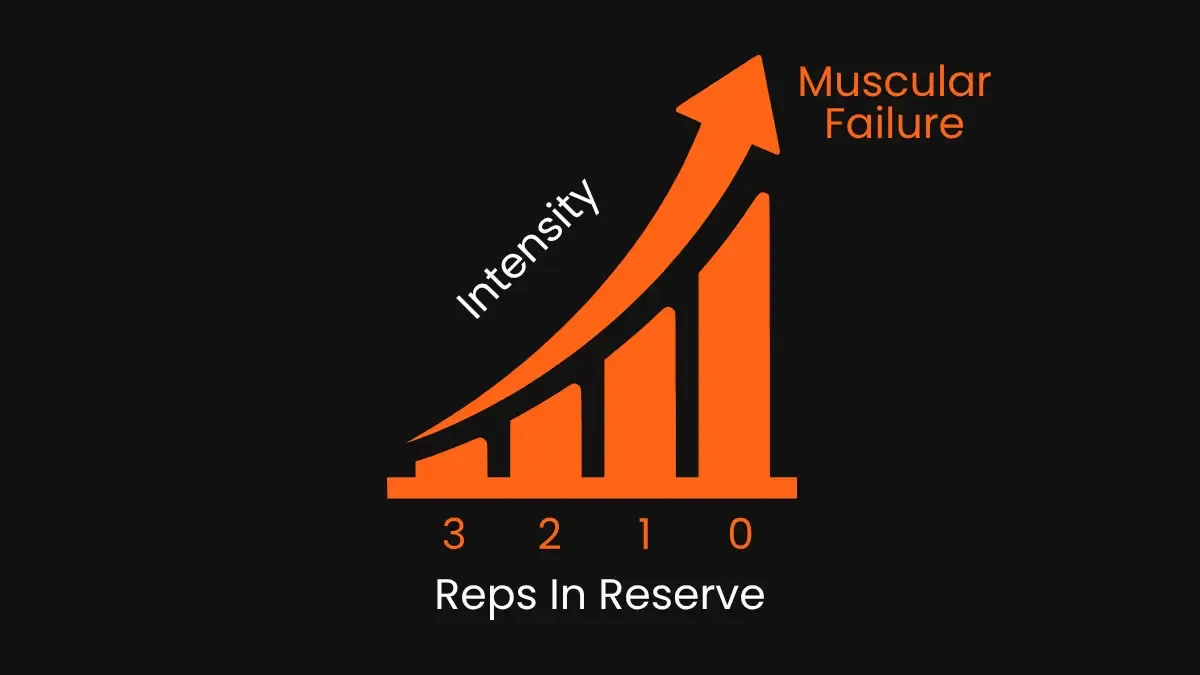
Intensity can be measured in several ways, and traditionally it has been measured as a percentage of an individual’s one rep max. If an individual can lift 100kg for 1 repetition, 100kg would be their one rep max. If the same individual were to lift 80kg they would be working at 80% of their one rep max. Therefore, repetition ranges also define intensity. A set with fewer reps using a heavier weight would be considered a higher intensity set compared to a set with more reps performed with a lighter weight.
Defining Intensity When Training To Build Muscle
The above definition of intensity is useful when our training goals are more focused on developing maximal strength; however, there are other definitions of intensity we can use. Some definitions are more useful and applicable when the goal is hypertrophy (building muscle) and are less strength-based. For hypertrophy-specific training, we can measure the intensity of a set by its proximity to muscular failure, as the later reps in a set are the most stimulative for hypertrophy. This ensures that sets are high quality and are effective when the goal is to build muscle.
Reps In Reserve
A simple and effective way to measure the intensity of a set is to use reps in reserve (RIR). This is an autoregulation technique, similar to RPE, that uses a perceived exertion scale. Reps in reserve or RIR measure the intensity of effort relating to how far we are from muscular failure in the set we are performing.
How To Calculate Reps In Reserve
When performing a set, we use the RIR scale to measure how far we are away from muscular failure. For example, looking at the reps in reserve chart, if we stopped a set and we could have performed one more rep, this would have been a 1 RIR. If our last rep was extremely difficult and we would not have been able to complete the next rep, then this would be a 0 RIR. If we attempted one more rep and failed, this would be muscular failure.
3 RIR: Could Complete 3 More Reps.
2 RIR: Could Complete 2 More Reps.
1 RIR: Could Complete 1 More Rep.
0 RIR: Could Not Complete Another Rep.
Failure Set: Attempted Another Rep But Was Unable To Complete.
The RIR Scale is a simple method and is a useful tool which allows us to measure the intensity of our sets and can also help us standardise the effort and therefore the quality of our sets in a training session, and how stimulative they are for muscle growth.
Effective Reps
Another method of measuring intensity that can be useful is the concept known as effective reps. This is somewhat related to RIR because it quantifies the later reps of a set as we begin to fatigue and get closer to muscular failure. These last few reps are the most stimulative for muscle growth, the reps where an involuntary slowing down of the concentric (lifting) part of the rep occurs.
If a set does not end with this involuntary slowing down of the reps, it is not a high-quality set, at least in terms of being maximally stimulative for hypertrophy (muscle growth). It is important to understand that the reps performed earlier in a set are likely still having some effect on stimulating muscle growth by placing tension on the muscle and contributing to overall volume, although this may depend on the rep range we are using.
There is some debate on the validity of the effective reps concept; however, we find the concept of effective reps along with RIR to be a simple and effective way for people to understand what a high-quality set looks and feels like.
What Does The Research Point To?
Recent meta analysis’s looking at previous research has suggested that training to muscular failure is not necessary to build muscle and can even be counterproductive due to factors such as reducing overall training volume performed within a session and accumulating extra fatigue which can affect recovery. A 2019 paper from the Journal of Strength and Conditioning Research even showed that stopping short of muscular failure is more effective for hypertrophy. Performing sets at a too low level of intensity for example at a 4 or 5 RIR is likely not effective for maximising muscle growth as shown in this study. Most coaches and researchers will usually recommend a 0-3 RIR as being effective for hypertrophy or muscle growth.
Some research shows that when lifting lighter weights the proximity to muscular failure is more important than when lifting heavier weights. In simple terms, performing a higher repetition set with a lighter weight will result in less muscle fiber recruitment at the beginning of a set compared to a heavier low repetition set. The reps at the beginning of the set do not require full muscle fiber recruitment, this is only achieved by taking the set to a high proximity to muscular failure. With heavier loads more muscle fiber recruitment is required even for the first rep of a set, because of the heavier weight.
What Do We Recommend?
There is some debate over how research studies are performed and whether research performed on untrained individuals applies to trained lifters. Untrained individuals will likely be able to build muscle training further away from failure simply because their muscles will be responsive to any new stimulus. Trained individuals will need to train at closer proximity to muscular failure to stimulate muscle growth.
For this reason, we recommend training at a 0-1 RIR for most exercises and in most situations. We would not recommend working at less than a 1 RIR in most situations and would prefer to see sets performed at higher intensities, even if this means performing fewer weekly sets. As long as it is safe to do so and training volume is low to moderate, we like to use a 0 RIR for most exercises, especially machine and isolation exercises. Some sets can also be taken to muscular failure.
What Are The Benefits Of Using Reps In Reserve?
Here are some of the main benefits of using Reps in reserve (RIR).
Set Quality And Progression
Using RIR can help us perform effective, high-quality sets and can also help standardise our sets for specific exercises, which can be useful for tracking progress over time more accurately. It can also help us select an appropriate weight for an exercise without having to know our one-rep max and can also help manage progression. We can use RIR to determine whether we need to increase weight on an exercise or if a load increase is too great.
Reps in reserve can also help us maintain intensity on days when we may not be at our strongest. We can still work towards our RIR target even if the load is reduced or fewer reps are possible. While our overall volume may be lower on that day, we’ve still maintained a chosen intensity level using RIR.
Fatigue Management
RIR can help manage fatigue and therefore maintain performance over time. We can choose which exercises to perform at higher intensities and which should be performed further away from muscular failure. In this way, an individual can establish the appropriate amount of stress they can progress with and recover from. Some exercises can be pushed closer to muscular failure with little or no detrimental effects, whilst others can produce too much fatigue and will affect progress. It can also help prevent excessive muscle damage, which can be a problem when training to failure too often.
Injury Prevention
RIR is an important tool that can be used for injury prevention. As mentioned previously, some exercises are just not appropriate to be taken to muscular failure or even 0 RIR, at least most of the time. Heavy barbell compound lifts should not be taken to failure, especially for stronger individuals who can lift large amounts of weight. They are likely not gaining any extra benefits from taking these lifts to failure; however, the risk of injury, as well as the high amounts of systemic stress and accumulated fatigue, rise exponentially.
Tracking
Reps in reserve can be used to track progress on different exercises; it is a measurable number we can use to see if we are gaining strength over time. For example, if we can bench press 100kg for 8 reps hitting a 1 RIR, and in a few months we can perform the same weight and reps with a 3 RIR, then we know we have made significant progress.
Practical Application Of RIR
The use of RIR can be more or less applicable depending on the individual and the type of exercise being performed.
Beginners
Beginners will be less accurate when using RIR; they are not as good at predicting how far they are away from muscular failure and will often stop a set thinking they are one or two reps from failure when in reality they could have performed another five or even more! The opposite can also be seen, the people you see at the gym stuck under the bench press because they have failed the rep at the bottom.
It is fairly well known, and studies have confirmed that experienced lifters can predict how far they are away from muscular failure with a high degree of accuracy, and anyone who trains regularly knows this. Even when approaching failure, experienced lifters will know if they can perform one more rep, even if they know it is going to be an extremely slow rep. They also know when they will be unable to complete another rep and not to attempt it.
An important point to understand is that beginners will gain strength and build muscle even when training some way from failure, simply because they are in an untrained state and will respond well to any new stimulus. At this stage, technique and learning basic movement patterns should be the main focus, and progression should be easy, adding weight and/or reps each week.
For individuals towards the end of the beginner stage, it may be worth testing out where their true failure is for certain exercises, allowing them to better understand RIR and start implementing it into their training. A simple way to do this is to perform a repetition maximum test. Simply select an exercise that can be performed with good technique and a high degree of effort, and take a set to complete muscular failure.
Once the maximum number of reps is known, an individual can experiment with taking sets to 1, 2, and 3 reps from their maximum rep number to see what different RIRs feel like. This should be performed under supervision if using free weights, and we recommend a full recovery period of at least 5 minutes after the initial failure set or testing the different RIRs on a separate day.
Should Beginners Use RIR?
For beginner lifters, it may be best not to use RIR. When learning to lift, it can be argued that the main focus should be on performing the exercise with good form. A beginner lifter will have enough going on in their head without having to think about RIR. In our free beginner program, we give the advice of simply performing as many reps as possible while maintaining good form.
If you think you are able to perform an extra rep with minimum or no form breakdown, then you should attempt the rep. If you are not sure you will be able to complete the next rep, or if you did attempt it there would be a significant breakdown in exercise form, then you should stop the set. Since we know beginners can train a little further away from muscular failure and still make progress, the precise RIR number is not as important. There will be plenty of time to train at a higher intensity level in the future.
Free Weight Compound Exercises
Using reps in reserve for free weight compound exercises, especially the heavy barbell lifts, is important and necessary. The RIR concept came from the world of strength and powerlifting, and is even more important to use the stronger you are. Going to failure or even to 1 rep from failure for some of these lifts is just not necessary. These lifts will produce too much systemic stress, and fatigue will accumulate quickly, making progression difficult. We recommend a 1-3 RIR in most situations, depending on the exercise and how advanced an individual is. Your overall weekly training volume will also affect this number.
Machines
Machines are generally safer and will produce less fatigue than free-weight exercises; therefore, lower RIRs can and probably should be used if the goal is to maximise muscle growth. The problem of form breakdown as we work closer to muscular failure is also less of a problem when using machines. We recommend a 0-1 RIR for most situations. Going to complete muscular failure at times, depending on the machine, is also a viable strategy.
Isolation Exercises
Similar to machines, isolation exercises working smaller muscle groups will produce far less fatigue and are also safer, allowing us to work at a much closer proximity to muscular failure. We recommend a 0-1 RIR for isolation moves and do not see a problem taking sets to complete muscular failure often. For example, training at a 0 RIR for most sets and taking your final set to complete muscular failure. You can also experiment with taking all isolation moves to failure if your recovery is good and your weekly set volume is not too high for these exercises.
Technical Failure
When performing sets at a close proximity to muscular failure, proper form is vital. We recommend ending a set at the point of technical failure. This is when there is a noticeable breakdown in form or technique, and this is more likely to happen as we get closer to muscular failure, especially in beginners and even early-stage intermediates. In this situation, it may be better to work at a slightly higher RIR to prevent injury and ingrain proper technique. This will be more applicable to free-weight exercises. More experienced lifters can maintain excellent form even as they approach muscular failure, the only difference being that there is an involuntary slowdown of the later reps in a set.
Conclusion
When the goal is to maximise hypertrophy, we must perform high-quality sets at a high level of intensity to ensure they are stimulative for muscle growth. Reps in reserve are a useful and effective tool we can use to ensure we are working at an adequate intensity level at a close enough proximity to muscular failure. They can also help with things such as progression, fatigue management, and injury prevention, and in doing so, help you achieve your physique goal.